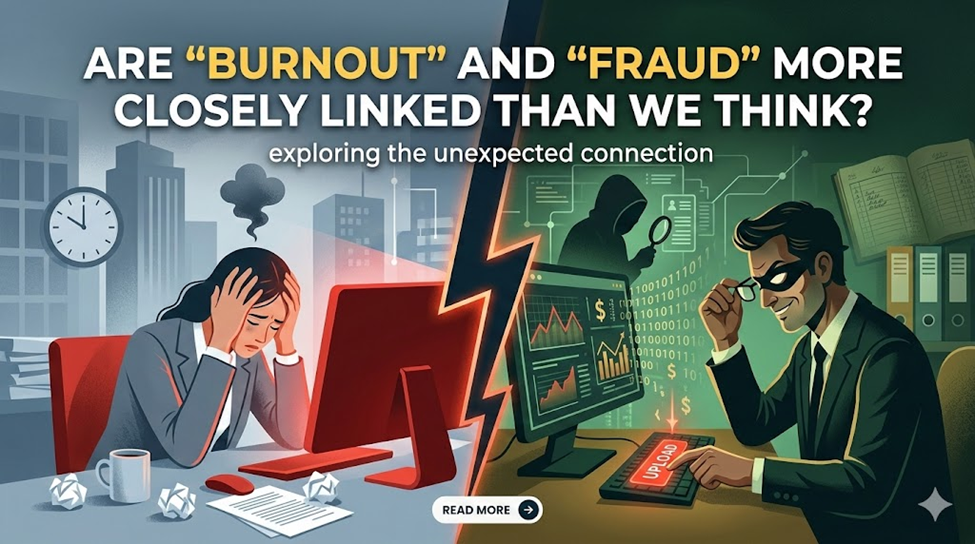
Are “Burnout” and “Fraud” More Closely Linked Than We Think?
When a company discovers a significant ethical breach—falsified safety records, a doctored expense report, or a bypassed vendor screening—the immediate reaction is usually to look for a “bad apple.” Leadership assumes the employee was inherently malicious or greedy.
But if you sit down with forensic accountants and organizational psychologists, they will tell you a different story. In the modern corporate landscape, the trigger for misconduct is rarely raw greed. More often than not, it is exhaustion.
Corporate leaders traditionally view employee burnout through the lens of human resources: it is a retention issue, a healthcare cost, or a productivity killer. However, when an employee is stretched beyond their cognitive and emotional limits, they don’t just lose their enthusiasm. They often lose their ethical footing.
The Anatomy of a Bad Decision
To understand why tired people make illegal or unethical choices, we have to look at the foundational theory of workplace crime: The Fraud Triangle.
Developed by criminologist Donald Cressey, the Fraud Triangle dictates that three elements must be present for an ordinary person to commit workplace misconduct:
- Opportunity: The ability to commit the act (e.g., access to the company credit card or the safety log).
- Pressure: A non-shareable problem driving the behavior (e.g., crushing debt or a threat of being fired).
- Rationalization: The internal justification that makes the act acceptable to the perpetrator.
Historically, companies focused all their energy on “Opportunity” by building massive walls of financial controls and audits. But burnout bypasses the walls by supercharging the other two points of the triangle: Pressure and Rationalization.
The Pressure of the “Always-On” Era
The modern definition of “Pressure” has evolved. It is no longer just about an employee struggling to pay off a gambling debt. Today, the most dangerous pressure is operational.
It is the pressure of a supply chain manager working 65 hours a week to cover for two laid-off colleagues. It is the pressure of a sales rep who has been told that missing quota this quarter means losing their job. When the brain enters this state of chronic survival mode, the prefrontal cortex—the area responsible for long-term planning and moral reasoning—is effectively hijacked. The brain stops asking, “Is this the right way to do this?” and starts asking, “What is the fastest way to make this immediate threat go away?”
The “Robin Hood” Rationalization
This is where burnout transforms from a wellness issue into an active risk. An exhausted, overwhelmed employee almost always feels undervalued. When the psychological contract between the employer and the employee breaks down, a dangerous narrative takes root.
The employee begins to tell themselves a story to justify their shortcuts: “I worked through the weekend for this company, so putting this personal dinner on the corporate card is just balancing the scales.” Or, “Leadership doesn’t care about my mental health, so why should I care if this vendor doesn’t have the right cybersecurity certifications?”
They don’t view themselves as criminals; they view themselves as underpaid martyrs extracting what they are owed.
Crimes of Apathy
It is crucial to recognize that the vast majority of burnout-induced breaches are not Hollywood-style embezzlements. They are crimes of apathy.
When cognitive fatigue sets in, the friction required to do the “right” thing simply becomes too high. An exhausted warehouse manager doesn’t forge a safety inspection because they want someone to get hurt; they forge it because doing the actual 45-minute physical walk-through means they will miss their daughter’s soccer game for the third time this month.
Merging Wellness with Risk Management
If we accept that burnout is a precursor to misconduct, then we have to fundamentally change how we protect our companies. We can no longer treat employee wellness and corporate ethics as two separate silos.
If your risk management strategy relies entirely on an annual 30-minute training video, it will fail the moment your employees are too tired to care about the rules.
To catch these overlapping issues, organizations need to look beyond the traditional whistleblower hotline. They need a proactive compliance solution that allows them to connect behavioral dots. For example, if a specific regional office is logging record-breaking overtime hours, experiencing high turnover, and simultaneously showing a sudden spike in minor policy overrides, that is not a coincidence. It is a smoke alarm.
Ultimately, the best defense against corporate misconduct isn’t a thicker rulebook. It is a well-rested, supported workforce that possesses the mental bandwidth to care about doing things the right way.