40G SR4 in Leaf-Spine Architectures: Design Considerations for Small and Mid-Sized Data Centers
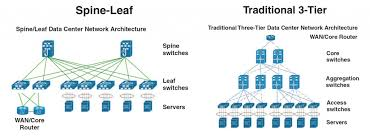
As small and mid-sized data centers evolve toward higher east-west traffic patterns driven by virtualization, hyper-converged infrastructure, and distributed storage, the leaf-spine architecture has become the preferred network topology. While 100G and 400G links dominate hyperscale deployments, 40G SR4 remains a practical and cost-effective solution for many enterprise environments. When properly designed, 40G SR4 can deliver predictable performance, manageable cabling complexity, and efficient port utilization within a leaf-spine framework.
Why 40G SR4 Still Fits in Enterprise Leaf-Spine Designs
In a typical leaf-spine architecture, each leaf switch connects to every spine switch, creating a non-blocking fabric. For small to medium-sized data centers with 10G server access, 40G SR4 provides a logical uplink aggregation option.
Instead of deploying multiple 10G uplinks per leaf, network designers can use a single 40G SR4 uplink, or several 40G links in parallel, to simplify topology while increasing bandwidth density. This approach reduces oversubscription ratios and streamlines switch port management.
For example, if a leaf switch supports 48×10G downlinks to servers, deploying 4×40G uplinks to spine switches provides 160G of aggregate uplink bandwidth. Depending on workload characteristics, this can achieve a balanced oversubscription ratio suitable for enterprise virtualization clusters or private cloud workloads.

Understanding 40G SR4 in Parallel Optics Environments
QSFP+ SR4 operates over parallel multimode fiber using MPO/MTP connectors. It transmits four parallel 10G lanes in each direction over eight fibers (within a 12-fiber MPO connector).
In leaf-spine deployments, this parallel optical design introduces both advantages and constraints:
Short-reach optimization: Ideal for data hall distances up to 100m over OM3 or 150m over OM4.
Low latency and power efficiency compared to long-reach alternatives.
Structured cabling dependency on MPO trunk infrastructure.
Because SR4 uses parallel fibers, structured cabling must be carefully planned to avoid polarity mismatches and excessive insertion loss. In small and mid-sized data centers, pre-terminated MPO trunks with cassette-based patching systems are often preferred to maintain flexibility.
Port Density and Switch Design Considerations
Port density plays a critical role in leaf-spine efficiency. QSFP+ ports used for 40G SR4 offer higher bandwidth per port compared to SFP+ 10G ports, allowing:
More aggregate bandwidth per rack unit
Reduced cable count
Lower front-panel congestion
For smaller data centers where switch port count is limited, using 40G uplinks conserves valuable spine ports. A spine switch equipped with 32 QSFP+ ports can support 32 leaf switches directly, maintaining a clean full-mesh topology.
However, designers must evaluate whether breakout capability is required. Some QSFP+ ports can be broken into 4×10G connections, which adds flexibility for hybrid environments. When planning spine capacity, it is important to account for future expansion and avoid exhausting QSFP+ ports too early.
Cabling Planning and Fiber Management
One of the most underestimated aspects of deploying 40G SR4 in leaf-spine environments is cabling architecture.
Because each SR4 link requires MPO connectivity, structured cabling must ensure:
Correct polarity type (Type A, B, or C)
Low insertion loss within optical budget
Clear labeling to avoid lane mapping errors
In small and mid-sized facilities, horizontal cable runs are typically short, which makes SR4 particularly attractive. However, cable routing pathways must be designed to prevent fiber congestion, especially when multiple 40G links aggregate toward spine switches.
Using high-density fiber panels and maintaining consistent trunk lengths helps optimize airflow and reduce operational complexity.
Oversubscription and Scalability Strategy
A common design mistake is focusing solely on link speed without modeling traffic patterns. 40G SR4 is best deployed where predictable east-west traffic exists and where incremental scaling is acceptable.
For growing environments, spine switches should be selected with additional QSFP+ capacity to allow seamless leaf expansion. If future migration to 100G is anticipated, designers may consider spine hardware that supports both QSFP+ and QSFP28, enabling gradual upgrades without a full topology redesign.
Conclusion
In small and mid-sized data centers, 40G SR4 remains a technically sound choice for leaf-spine architectures. It balances bandwidth, cost, port density, and power efficiency while fitting neatly within short-reach multimode environments.
When deployed with careful attention to uplink ratios, port density planning, and MPO-based cabling structure, 40G SR4 can deliver a scalable and resilient fabric, proving that thoughtful architecture design matters more than simply chasing higher speeds.